
Aging services and affordable housing are two fields that rarely explain themselves to each other. People who spend their days with older adults know the housing system from the outside, as a set of doors that mostly do not open. People who build the housing know it from the inside, as a stack of financing that has to close. What follows is the plain account almost nobody gets. It is short on dates and long on one argument: the country has built serious machinery for three ways of producing affordable housing, and almost nothing for the fourth.
Build, preserve, convert and activate. We have financing, measurement, incentives and risk infrastructure for the first three. For the fourth, activating housing capacity that already exists, there is no unit of production, no incentive, no financing pathway and no recognized moment at which anything is deemed to have happened.
That is not an argument against building. The country needs substantially more construction than it is doing. It is an argument that a housing system which counts only units built will keep missing the fastest-growing group that needs it.
Era one: the government paid to operate. Rent followed income.
From the Depression through the early 1980s, the federal government's main move was to cover part of the cost of running a building. Public housing in 1937 worked that way. Section 202, created in 1959 specifically for older adults with low incomes, worked that way. So did the Section 8 programs of the 1970s, which paid to construct new buildings with rental assistance attached from day one.
One consequence matters more than all the others. Because a subsidy covered operating costs, the rent could be set as a share of what the resident earned. Very low income meant very low rent. There was no fixed rent, so there was nothing for a landlord to test an applicant against.
You cannot be too poor for that kind of housing. Hold onto that sentence. It is the whole difference between era one and era two.
Era two: the government started paying to build. Rent became a number on a table.
Two decisions by Congress, three years apart, changed the machine.
In 1983, Congress ended the part of Section 8 that paid for construction. The rental assistance survived. The building money did not.
In 1986, Congress created the Low-Income Housing Tax Credit, and it has been the country's principal way of producing affordable homes ever since. It is not formally a replacement for what was repealed, but it took over the job.
Here is how it works, because the mechanism is the point. Congress gives each state an annual pot of tax credits based on population. The state housing agency, Oregon Housing and Community Services in our case, runs a competition for them under a document called the Qualified Allocation Plan. Developers apply, roughly three quarters of them for-profit. The winner sells the credits to investors, mostly banks, for cash up front. In 2024 about $28.9 billion in equity came in this way, around 80 percent from banks. That cash means less borrowing, which is what lets the building charge below-market rent.
And then the fact that governs everything downstream:
The tax credit pays to build. It does not pay to operate.
With nothing covering operating costs, rent cannot move with each resident's income. It has to be a set amount, published on a table. And a set rent has to be tested against something. So properties do what landlords everywhere do and ask applicants to document income at some multiple of the rent, commonly two, two and a half or three times.
Nobody wrote that requirement. No agency issued it. It is what ordinary underwriting does when it meets a rent that regulation fixed in advance. Because it is not a rule, nobody publishes it, which is why applicants find it only at the point of being turned down. We measured what it does to an older adult on the average Social Security benefit, and She Qualifies. She Still Cannot Get In. is the short version for a caseload.
The same design explains why new buildings are set at 60 percent of area median rather than 30. A rent at the 30 percent band usually will not cover the cost of running the building without an ongoing subsidy, and that subsidy is scarce. So the cheapest homes are the rarest, and the band that does get built is the one whose fixed rent produces the highest income requirement. Both ends move against the same household.
HUD's own tenant data shows the result. More than half the households living in tax credit homes have incomes at or below the deepest 30 percent band, and about 48 percent receive monthly rental assistance. The poorest residents of these buildings are largely there because a subsidy came in with them. The building by itself did not reach them.
Two things people get wrong about era two
The new buildings are not sitting empty. Surveyed tax credit properties report median physical occupancy around 97 percent. What happens at lease-up is not a vacancy, it is a substitution: a somewhat better-off applicant takes the apartment rather than the apartment standing open. That is why the problem has been so easy to miss. There is no empty building to point at, and the person who could not get in appears in no report anywhere.
Affordability does not last 15 years. Fifteen years is the window during which an investor's credits could be recaptured. That is an investor's timeline. The affordability commitment is at least 30 years, recorded on the property so it binds the next owner, and many states require longer.
What changes at year 16 is that the IRS steps back, and enforcement becomes a contract matter with the state agency. The owner still may not charge above the limits, evict without good cause, or refuse an applicant for holding a voucher.
What ends it early is the qualified contract. After year 14, an owner may ask the state agency to find a buyer who will keep the building affordable. The agency gets one year. The price the law requires is usually higher than an affordable-housing buyer can pay, so no buyer appears, the year runs out, and the restrictions end. It has taken roughly 10,000 homes a year out of the program, and more than 110,000 since 1990. Many states now require owners to waive the right in order to win credits, and HUD has required it since 2025 for certain FHA financing.
When restrictions do end, residents living there at that moment are protected for three years from eviction without good cause and from rent increases. As apartments turn over, the owner can charge market. It is a wind-down, not a reprieve.
Why building more does not automatically mean having more
Here the evidence is more interesting than the headline. Most expiring properties do not become luxury apartments. Freddie Mac found about 87 percent of tax credit properties still restricted, and among those that had exited, roughly 61 percent of apartments remained affordable at the 60 percent level.
Now the other half of that finding. In the same set of exited properties, no apartments remained affordable at the 30 percent level. None.
Exit does not usually mean conversion to luxury. It means the deepest tier quietly disappears, which is precisely the tier your caseload needs.
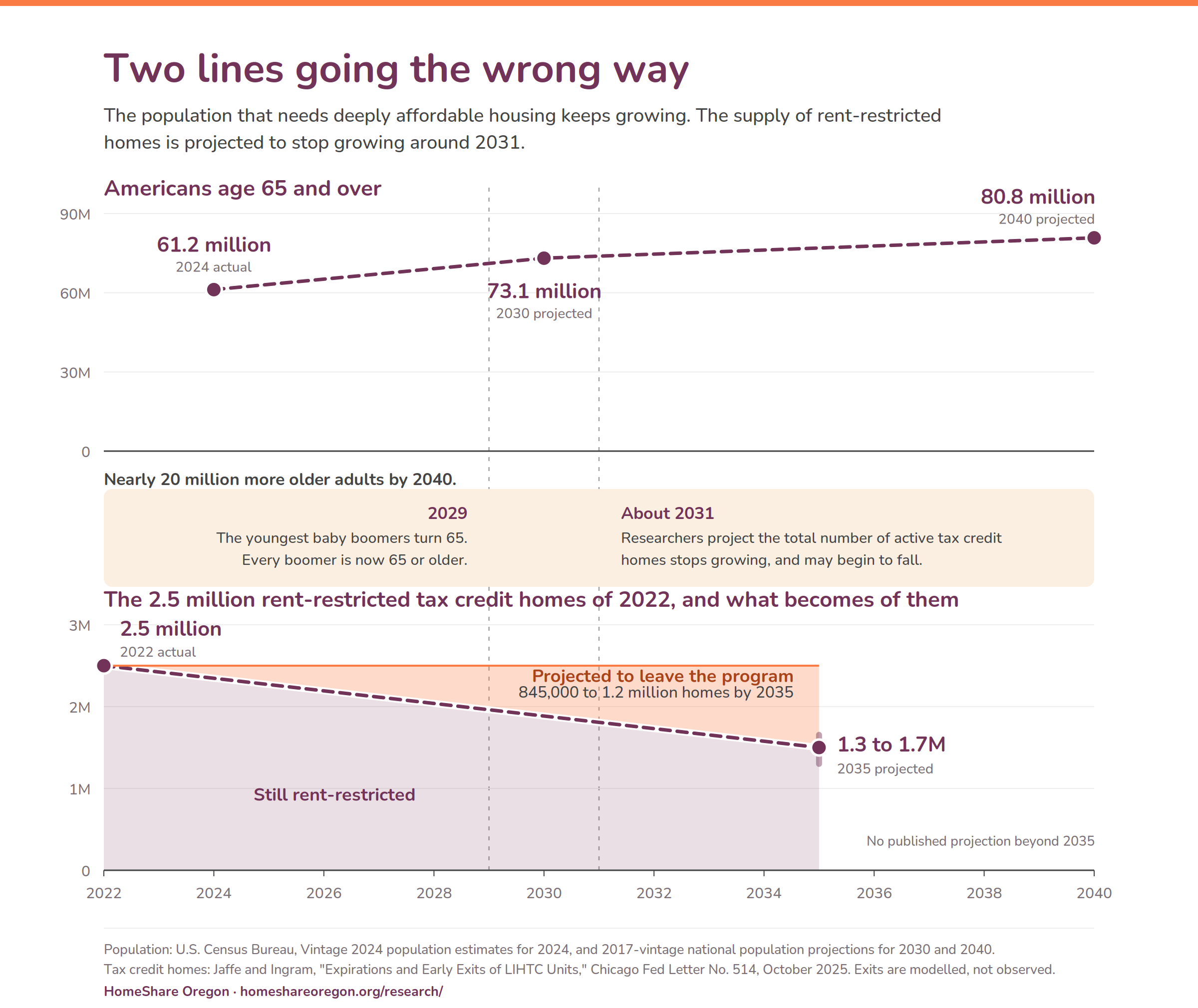
There were roughly 2.5 million active tax credit homes in 2022. Federal Reserve Bank of Chicago researchers project that about 40 percent will be gone by 2035, once early exits are counted. They also project the total number stops growing around 2031. Public housing loses about 10,000 homes a year to disrepair. USDA's rural program is projected to lose nearly all its stock by 2050.
Meanwhile the youngest baby boomers turn 65 in 2029. Renter households age 60 and over grew by 2.3 million, 26 percent, between 2014 and 2024, and the National Low Income Housing Coalition projects 5.5 million more older adult renter households between 2020 and 2040. The two lines cross the wrong way, and nothing in the current pipeline changes that, because the pipeline builds at 60 percent with a fixed rent and an income test on the door.
Era three: the capacity nobody counts
This is where the argument turns from history into a proposition.
The Rooms Already Exist counted the capacity from Census microdata. About 35 million spare bedrooms sit in homes owned by adults 65 and over, against 4.5 million older renters spending more on rent than is recommended. Nearly eight rooms for every person in trouble. Every state and the District of Columbia holds more spare rooms than it has older renters in housing trouble. Not one state is short. Housing all of them would take about 13 percent of those rooms.
That is not a metaphor for capacity. It is a count of it. And it names both halves of your caseload at once. Alongside those 4.5 million renters are 7.7 million older homeowners, about one in four, under the same pressure from the other side of the same front door. One arrangement addresses both.
So compare the two pathways honestly.
| Building capacity | Activating capacity | |
|---|---|---|
| What is produced | A new apartment | An existing unused bedroom |
| Who produces it | A developer | A home provider |
| The moment it counts | Placed in service | No recognized event |
| Capital | Construction and permanent financing | No pathway |
| Incentive | Tax credits and subsidies | None |
| Risk | Insurance, guarantees, reserves | Not standardized |
| How it is measured | Units, housing starts | No unit of measurement |
| Duration | 30-year use restriction | One year, renewable |
| Occupant protections | Fair housing, inspection, income certification | Partial |
| Where the housing payment goes | Owner or partnership | The home provider, directly |
Read the protection row closely, because we are not going to pretend it away. The federal fair housing exemption for owner-occupied dwellings of four units or fewer covers most home sharing arrangements. It is partial rather than total. The ban on discriminatory advertising still applies, and state and local law is often broader. Closing that gap is named in our research agenda rather than assumed away.
The asymmetry is not an accident of markets. It is the result of choices about what public policy decided to make financeable. America did not simply declare affordable housing valuable. It manufactured an asset, defined the unit of production, set the compliance standard, built the financing, insured the risk and gave several parties a reason to participate. That machinery is real and it works.
Nobody did any of that for a spare bedroom. Which is odd, because federal rules already permit one. HUD regulation states plainly that an assisted family may reside in shared housing. The rules are fully worked out, down to separate leases, pro rata rent, space standards and the participation of a resident owner. That pathway exists and is barely used. Working out whether the binding constraint is regulatory, financial, administrative or behavioral is the first question our research agenda has to answer.
What Housing Capacity Parity proposes
The framework is short, and it is deliberately written as an invitation to be argued with rather than a finished answer. Five things would have to be built:
- Measure it. Define the Affordable Room-Year: one verified bedroom, offered at a qualifying affordable rent, occupied by an eligible household for one year. Define the activation event, the equivalent of "placed in service." Without a standardized unit, none of the rest is possible.
- Incentivize it. Treat the home provider as what they functionally are, a micro-provider of affordable housing, and work out what incentive is appropriate for placing a bedroom into affordable service.
- Finance it. Establish which existing mechanisms can already support activation: community development financial institutions, program-related investments, state housing trust funds, outcome-based public contracts.
- De-risk it. Standardized insurance, guarantees, mediation, legal assistance, and clarity on how room rental income interacts with means-tested benefits, which is currently a direct deterrent for the lowest-income home providers.
- Verify it. Trusted infrastructure for identity, property, affordability, agreement, occupancy and outcome. Investors and public payers finance standardized, verified assets.
One honest note about why this needs a constituency. The activation pathway is efficient precisely because most of the money reaches a household rather than a transaction chain. That is the point of it. But the same efficiency means it generates no fee pool, so it cannot fund its own advocacy the way production finance does. It has to be built from home providers, from insurers and verification providers, from health systems, and from the organizations that watch this pattern repeat every week.
What this changes for your organization
Two things, one immediate and one longer.
Immediate. Your staff can stop treating a screening failure as bad luck. Three questions to each property, one phone call each: what income multiple do you require, which homes carry rental assistance, and are any apartments designated below 60 percent. Together they change which applications are worth someone's morning.
Longer. If you serve older adults and you have watched an eligible person fail to get in, you already hold the evidence this argument needs. What we would ask is that you have something to offer in the meantime, and that the next time a fund is announced, somebody in the room asks what it buys for a person living on $2,071 a month.
The timeline, if you want it
| Year | What happened |
|---|---|
| 1937 | Congress creates public housing during the Depression. Local authorities build and own; federal money helps operate. Rent follows income. |
| 1949 | The Housing Act sets a national goal of a decent home for every American family. Still on the books. Never met. |
| 1959 | Section 202 begins, purpose-built for older adults with low incomes. More than 400,000 homes since. Average resident income about $16,262 as of 2023. |
| 1974 | Section 8 arrives, doing two jobs: rental assistance, and money to construct buildings with that assistance attached. |
| 1983 | Congress ends the construction half. The assistance survives. |
| 1986 | Congress creates the Low-Income Housing Tax Credit. It pays to build, not to operate. |
| 1998 | The Faircloth Amendment caps public housing. The stock may be replaced but not expanded. |
| 2012 to 2017 | Congress funds no new Section 202 construction. Note carefully: this was Section 202 only. Tax credit construction continued at scale throughout. Section 202 funding resumed in 2018 at a fraction of historic levels. |
| 2018 | Income averaging arrives. A building may designate apartments from 20 to 80 percent in steps of 10, as long as the average lands at 60 or below. |
| 2025 and 2026 | Congress again funds no new Section 202 construction. The fiscal 2027 request proposes eliminating it, while renewing existing contracts. |
Read next
If you work with older adults directly: She Qualifies. She Still Cannot Get In. turns this into three questions and a referral practice.
If you want the underlying research: Housing Capacity Parity is the framework, The Rooms Already Exist is the capacity count, and Between the Ceiling and the Floor draws both income limits for any county in the country.
Sources
- Program history and mechanics: Housing Act of 1937; Housing Act of 1949, 42 U.S.C. 1441; Section 202 as amended; the 1983 repeal of Section 8 new construction authority; Tax Reform Act of 1986; Faircloth Amendment, 1998; 26 U.S.C. 42.
- Section 202 funding: National Low Income Housing Coalition, 2026 Advocates' Guide, chapter 4, and HUD's FY2027 congressional justification. Average resident income is 2023 data. The 400,000 figure is cumulative production since 1959, not standing inventory.
- Income averaging: 26 U.S.C. 42(g)(1)(C); IRS final regulations T.D. 9967 (2022) and T.D. 10036 (2025).
- Compliance and extended use: 26 U.S.C. 42(i)(1) and 42(h)(6). Qualified contract volumes: National Council of State Housing Agencies, 2021, and Tax Credit Advisor, 2023. FHA waiver requirement: HUD Notice 2024-N-6.
- What happens after exit: Freddie Mac Multifamily, Risk and Impact of LIHTC Properties Exiting the Program, 2022.
- Expiration projections: Jaffe and Ingram, "Expirations and Early Exits of LIHTC Units," Chicago Fed Letter No. 514, October 2025. Modelled, not observed.
- Other stock losses: Harvard Joint Center for Housing Studies, America's Rental Housing 2026.
- Tenant characteristics and occupancy: HUD LIHTC tenant tables, 2023; CohnReznick, 2025 Affordable Housing Credit Study, a survey of a large portfolio rather than a census.
- Equity volume: CohnReznick, 2024 LIHTC Equity Market Volume Survey.
- Demographics: U.S. Census Bureau Vintage 2024 estimates and P25-1144 projections, which are 2017-vintage; Harvard Joint Center for Housing Studies, America's Rental Housing 2026, for renter household growth, which is age 60 and over.
- Shared housing under existing rules: 24 CFR 982.615 to 982.618. Fair housing exemption: 42 U.S.C. 3603(b)(2), which is partial rather than total.
- Spare bedroom capacity: HomeShare America, The Rooms Already Exist, American Community Survey 2023 microdata. It counts possible capacity inside occupied homes, not proof that a room sits empty.
Nothing here should be read as a representation that any activity qualifies for Community Reinvestment Act consideration. This product uses HUD published data but is not endorsed or certified by HUD.